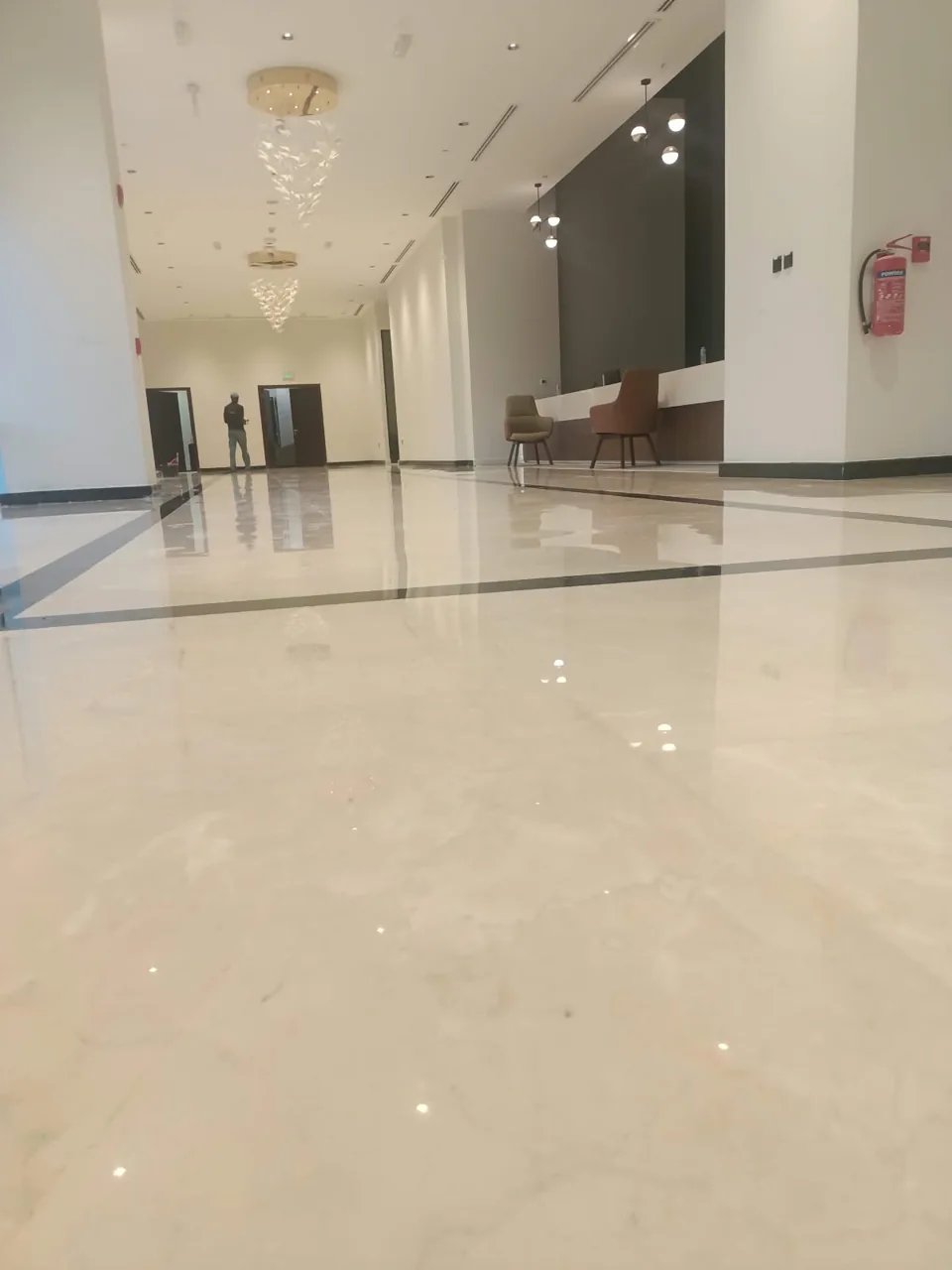

Marble polishing in Qatar is different from routine floor cleaning. Dar Al Mahara receives requests for marble care in Qatar, with the method considered according to the stone, its finish and condition. Photographs and an approximate area help explain whether the concern is dullness, surface marks, uneven appearance or a particular stain.
Contents
Marble polishing in Qatar: what to include in your request
Begin with the area and the change you can see: a dull traffic route, a ring after a spill, scratches near a chair or a difference between adjoining rooms. Send one overall photograph and a close view in ordinary light. Include the stone name, supplier information and previous treatment if known. A stone sold as marble, a marble-look tile and a resin-bound surface may require different care.
Useful information includes whether the floor was originally glossy or softly honed, whether a coating has been applied, and whether a mark appeared after a spill or new cleaner. A matte finish can be intentional. Explain the result you want while keeping the character of the existing stone in view; the strongest reflection is not automatically the correct finish for every room.

Preparing for the visit
Make a list of the rooms, clear small belongings and arrange access to the agreed floor area. Explain thresholds, steps, narrow doorways and the route for equipment. Keep a separate route for the household where the layout allows. Furniture moving is not provided; arrange it separately before the visit, and identify any fixed or heavy item that will leave part of the floor inaccessible.
Point out timber, carpet, metal, wall finishes and fitted furniture beside the stone. Agree protection at these boundaries and keep children and pets out of the working area. If other contractors will be painting, cutting or installing fittings, coordinate the sequence before the floor treatment so new dust or damage does not immediately obscure the result.
After the service
Obtain instructions for the actual finish and any product used. Ask separately about walking on the area, replacing furniture, fitting rugs and the first routine clean. A dry-looking surface does not establish every return-to-use requirement, especially if a treatment needs a period without traffic. Follow the confirmed instructions rather than copying a waiting time from another floor.
Keep grit away from the entrance and use a clean, soft routine-care tool suited to the stone. Products containing vinegar, lemon or other acids can dull or etch calcareous stone such as marble. A general bathroom descaler or abrasive cleaning powder is not a substitute for a stone-compatible cleaner. Keep the care instructions with the stone’s name for anyone who cleans the home.

Booking and related information
For marble polishing, provide the approximate area, photographs in ordinary light and details of scratches, dull patches or previous coatings. Ask which steps are included and how furniture, edges and adjacent surfaces will be handled. Review published prices and contact Dar Al Mahara on WhatsApp to confirm availability and the agreed scope.
You can also browse the services directory and the cleaning guides for related advice. Specialist tasks should be specified separately from general cleaning.
Identify the surface and the finish you want
The stone, its surface finish and any treatment already on it all matter. A polished marble surface reflects light differently from a honed surface; a lower-gloss area is not necessarily unfinished work. Ask the supplier for the material name and maintenance information if available. Colour and veining alone cannot establish that the floor is marble or identify a suitable process.
At inspection, distinguish the existing finish from residue, wear and a local defect. If the floor contains borders, inserts or replacement pieces, identify them separately. A decorative dark strip may differ from the lighter field around it. Do not perform an acid, scratch or improvised chemical test on an installed surface to identify it.
The Natural Stone Institute’s consumer-care guidance explains the sensitivity of calcareous stone to acids, the importance of removing abrasive grit, and the need for stone-appropriate products. Its advice supports careful routine care; selecting a restoration method still requires assessment of your floor.
Cleaning or polishing: which is needed?
Cleaning removes suitable soil or residue from a surface. Polishing works on the appearance of the finish. More extensive refinishing or restoration can involve correcting a worn or damaged surface, while repairing a crack, loose tile or failed joint is a different task. These terms should describe what will happen to your stone, rather than be used interchangeably in a quotation.
| What you observe | What needs distinguishing | Useful next question |
|---|---|---|
| A streaky or smeared appearance after mopping | Residue or soil versus a changed finish | Can suitable cleaning and a review of the care product resolve it? |
| A dull splash or ring | Acid etching, a stain or both | Does the mark affect the finish, the colour or both? |
| Fine marks on a walking route | Surface wear and scratches | What improvement is realistic across the whole route? |
| A deep scratch, crack or chipped edge | Damage needing repair or specialist refinishing | What separate assessment and work are required? |
| White powder that returns | A possible moisture-related issue | Should an installer check the cause before appearance work? |
A stain can change the stone’s colour, while etching changes the finish; one spill can cause both. Repeatedly cleaning an etched patch with a stronger product does not make it ordinary dirt. The Institute recommends professional advice for etched areas and deeper scratches. Do not apply a coating simply to hide an unresolved defect.
How is the work area prepared?
Mark out the included rooms and the adjoining areas that must be protected. Keep a route to exits and essential rooms clear, and explain any lift or building-entry arrangements. List fragile items and finishes near floor level before the work begins. A room-by-room plan makes it easier to keep people away from treatment areas and review each section afterwards.
Where a test or sample area is appropriate, agree its location and review it in the lighting normally used in the room. Look at the finish and the boundary with the surrounding stone, not just the reflection directly under a lamp. Use the result to clarify expectations before extending work; a test cannot establish the condition of every slab or repair elsewhere.

Describe the floor you have before choosing the finish you want
Inspect the floor as a whole before concentrating on one blemish. Note traffic routes, areas beneath rugs, places beside plant pots and transitions to other rooms. A kitchen splash, an entrance worn by grit and a dull patch where a different cleaner was used are different histories. Recording them separately gives the inspection a useful starting point.
Photographs should show representative lighting, the boundary of the requested work and the surrounding untreated stone. Keep any previous repair visible. The aim is to identify suitable care and realistic improvement, while preserving the features and finish that belong to the material. A local correction can look different beside an untreated floor, so the extent of work and its transition should be discussed together.

Identify each area of stone
Use room names or another clear reference for the areas requested. Explain whether the work concerns a floor, steps, a landing, a threshold or another surface. Do not apply a general floor quotation automatically to every stone element. An area above a staircase, a vertical surface or a detailed edge may require a different assessment, access arrangement or scope.
If you have supplier documents or a care label, send the relevant information. If you only know that the surface was described as marble when installed, explain that limitation. Tell the team about previous coatings, treatments or repairs when known. Do not perform a chemical test, scratch the surface or remove a piece to confirm the material for the enquiry.
Photograph the overall appearance and the concern
Take an overall photograph showing the area and a closer photograph of the mark or dull patch where possible from a safe position. Explain which part you want reviewed. Use ordinary, representative lighting and avoid editing the image to hide the condition. If the appearance changes with viewing direction or light, describe that observation without deciding its technical cause.
Include existing cracks, damaged joints or a repair that looks different from surrounding stone. A photograph helps explain the request but cannot establish the depth of damage or the suitability of a particular process. Do not press, tap or lift a loose or damaged section to demonstrate the issue. A qualified assessment may be needed before any cosmetic work is considered.
Explain the result you want in practical terms
Describe the intended appearance in everyday terms: maintaining a soft honed finish, improving a worn route or bringing a whole room closer to its existing polished appearance. Include a photograph of an unaffected area of the same floor where possible. A picture from another property is less useful because the stone, lighting and finish may all differ.
Natural variation, veining, filled areas and older repairs can remain visible after appropriate work. Discuss these details before requesting uniformity across different materials. For a shared entrance or wet-use area, consider how the space is used as well as its appearance, and ask the responsible property professional about suitability. Polishing should not be described as a promise of a slip-proof surface.
List dirt, marks and damage separately
Record the cause where known: a drink, cooking oil, cosmetics, a metal plant container, building residue or an unidentified cleaner. State when it happened and what was applied afterwards. The location and shape are useful clues, but colour alone is not a diagnosis. A ring may involve a surface deposit, a stain or etching, and these need different decisions.
For a fresh spill, promptly blot rather than spread it by wiping. Follow the stone supplier’s and compatible product’s care instructions for subsequent cleaning. Avoid mixing cleaners or adding an acidic descaler because a mark remains. For an old, deep or unknown stain, ask for assessment before another treatment; the most aggressive household product may damage the finish without resolving the stain.
Describe cracks, unstable pieces, damaged joints and recurrent dampness separately. If white powder repeatedly appears, tell the installer or appropriate specialist; polishing does not resolve a moisture source beneath the floor. Do not lift, tap or fill a loose piece to demonstrate it. Protect the area from use as appropriate while arranging the relevant assessment.
Measure the requested area without assuming the scope
List each room and measure accessible rectangular sections by length multiplied by width. For an L-shaped room, divide it into rectangles, calculate each area and add them. For example, a 4-by-5-metre section is 20 square metres and a 2-by-3-metre section is 6 square metres: together they describe 26 square metres before the working area is confirmed.
Record fixed cupboards, excluded rooms, steps, thresholds and decorative edges separately. Do not use the property’s total floor area as the stone-care measurement. A staircase or vertical surface also needs its own description, rather than being assumed to follow a simple room-floor rate.
Dar Al Mahara’s marble work rate is QAR 35 per square metre, with the stone’s condition and the included work confirmed before booking. As an area calculation, 30 m² × QAR 35 = QAR 1,050. The 26-square-metre measurement example would give QAR 910 at that rate if that area and scope were confirmed. These are calculations, not a quote for repairing, replacing or supplying stone.
Keep the quotation readable
| Quotation point | Question to resolve |
|---|---|
| Areas | Which rooms or sections are included, and what measurement is being used? |
| Process | Does the offer concern cleaning, polishing, local correction or another confirmed form of care? |
| Repairs | Are cracks, joints or damaged pieces excluded or covered by a separate identified task? |
| Preparation | What floor needs clearing beforehand, and how are adjacent surfaces protected? |
| Handover | What use and care instructions apply to the actual work and finish? |
Coordinate furniture and fixed fittings
Identify fixed cupboards, built-in benches, large planters and furniture that cannot be cleared beforehand. Record the resulting limits of the accessible floor so the quoted work and final review use the same boundary. Arrange a named person to manage the room contents and keep fragile items away from the equipment route.
At the edges, point out timber skirting, carpet, metal trim, glass and painted finishes. Agree the protection method appropriate to those materials. Adhesive applied to a delicate finish can create its own problem, so protection should be selected deliberately rather than improvised. Keep the working layout consistent with the photographs used to plan the visit.
Plan an occupied home in sections
If the family will remain in the property, describe which routes and rooms must remain available. Ask whether the proposed work can be arranged in sections and what limits apply. A requested order does not guarantee that every route can stay open throughout the service. Coordinate the plan before booking rather than directing people across an area that has not been released for use.
Tell the booking team about children, pets or another practical need relevant to the working area. Obtain the actual instructions and share them with the household, including anyone who will arrive after the visit. Do not substitute a waiting period from another floor or a general claim about immediate use for guidance about your surface and the work performed.
Arrange a lobby, office or shared entrance
In a workplace, identify who can approve access, coordinate visitors and receive the work. Explain business hours, restricted areas and the need for a route through the building. Discuss the arrangement with the property manager where a surface is shared. A tenant’s request does not automatically authorize changes to a building lobby or an area used by other occupants.
Keep responsibility for documents, equipment and stored items clear. The stone-care team should not be left to decide which office contents can be moved or discarded. If other services depend on the space, inform the responsible people before confirming the schedule. Access restrictions and working-area arrangements are part of the planning discussion, not details to leave unresolved until equipment arrives.
Coordinate with other contractors
Tell the team if painting, carpentry, appliance installation or other work will take place in the same area. Explain which activities are finished and which will continue after the stone service. Discuss the sequence so that the agreed work is reviewed against a known condition. Do not assume a completed visit includes another clean or polish after unrelated later work.
If another contractor needs to move furniture or work close to the treated surface, pass on the relevant instructions before that happens. Any change in area, access or planned task should be reviewed with the provider. A quotation based on an empty room may need reconsideration if furniture or building materials are added before the appointment.
Review products and routine-care instructions
Routine care starts with removing abrasive particles. The Natural Stone Institute recommends frequent dust mopping with a clean, untreated dry dust mop. Sand and grit can abrade stone as people walk across it. Keep entrance mats clean and use suitable slip-resistant backing. If a vacuum is used, check wheels and attachments for wear that could scratch the floor.
Use a neutral, stone-compatible cleaner recommended for the identified material and finish, following the supplier’s and product’s directions. Too much cleaner can leave a film or streaks, so a stronger concentration is not automatically better. Use clean tools and water, rinse where directed and dry with a soft cloth or suitable method. Keep acidic products and abrasive powders away from sensitive marble.
Sealing is a separate care decision. An impregnating treatment can improve resistance to staining but does not make the stone stain-proof. Some stones may not need it. Ask whether it is appropriate, what has already been applied, and what maintenance the particular product requires. It is not a substitute for repairing a defect or assessing an etched patch, and no universal annual sealing schedule should be assumed.
Agree how the result will be reviewed
Review the work after the relevant stage is complete and when the area is safe to inspect. Use similar lighting and viewing positions to the initial photographs. First look across the whole included floor, then examine the specific marks recorded before work. Daylight and artificial light can emphasise different features, so explain where and under which conditions a concern is visible.
- Check the rooms, boundaries and edge areas against the agreed list.
- Ask whether any remaining patch is residue, an old stain, etching, a repair or another observed limitation.
- Look at the transition to untreated stone where only part of a floor was included.
- Review adjacent surfaces and any access-related area that needs attention.
- Record completed work, deferred repairs and the actual care and return-to-use instructions.
If something needs review, identify its position with an overall photograph and a close view before applying another product. Keep the concern specific. Appearance checks do not establish the structural soundness of the installation, and the natural pattern of one piece should not be judged against the pattern of another.
Return the area to use under the confirmed guidance
Confirm when walking, moving belongings back, fitting rugs and routine cleaning may resume. These may be separate questions, depending on the method and any treatment used. Keep the agreed route clear until each section is released for use, and share the instructions with anyone arriving later.
When furniture returns, use a suitable arrangement for lifting and positioning it rather than dragging it across the finish. Check protective pads for trapped grit and replace damaged ones as appropriate for the furniture. If an area remains uncertain, photograph it and contact the provider before scrubbing it or covering it with a coating.
Update the record when planning future care
Keep a small care record: material and supplier, room names, treatment date, included area, product names where relevant and the instructions received. Add later spills, repairs or changes in cleaners. If a mark returns, this history can help distinguish a recurring cause from a new issue without assuming another full-floor polish is needed.
For English enquiries, call 70022290 with your area in Qatar, photographs, approximate measurements and the main concern. Use the earlier booking links to send the details and discuss the quotation. The appropriate interval for future care depends on the floor’s use and condition; it is not a fixed lifespan or permanent-shine promise.
When only part of a continuous floor is requested
If an entrance connects continuously to a living room, photograph both areas even if only the entrance is requested. Identify a clear boundary and discuss whether a local correction could leave a visible difference in gloss or texture. A border or doorway can help describe the scope, but it does not guarantee an invisible match.
For example, a homeowner might request attention to a worn route between the front door and hall while leaving the adjoining room untreated. Useful questions are whether residue or wear is involved, whether a sample is appropriate, and how the transition will be reviewed. The answer may support a local task, a wider scope or routine care first. Use these questions with your own floor’s inspection and proposed scope.